csprimer-algorithms
002 Convert to Roman
- understand the problem
- start from smaller problem
- found pattern, solve by recursions or loop etc
- create your own test, think line by line?
plan:
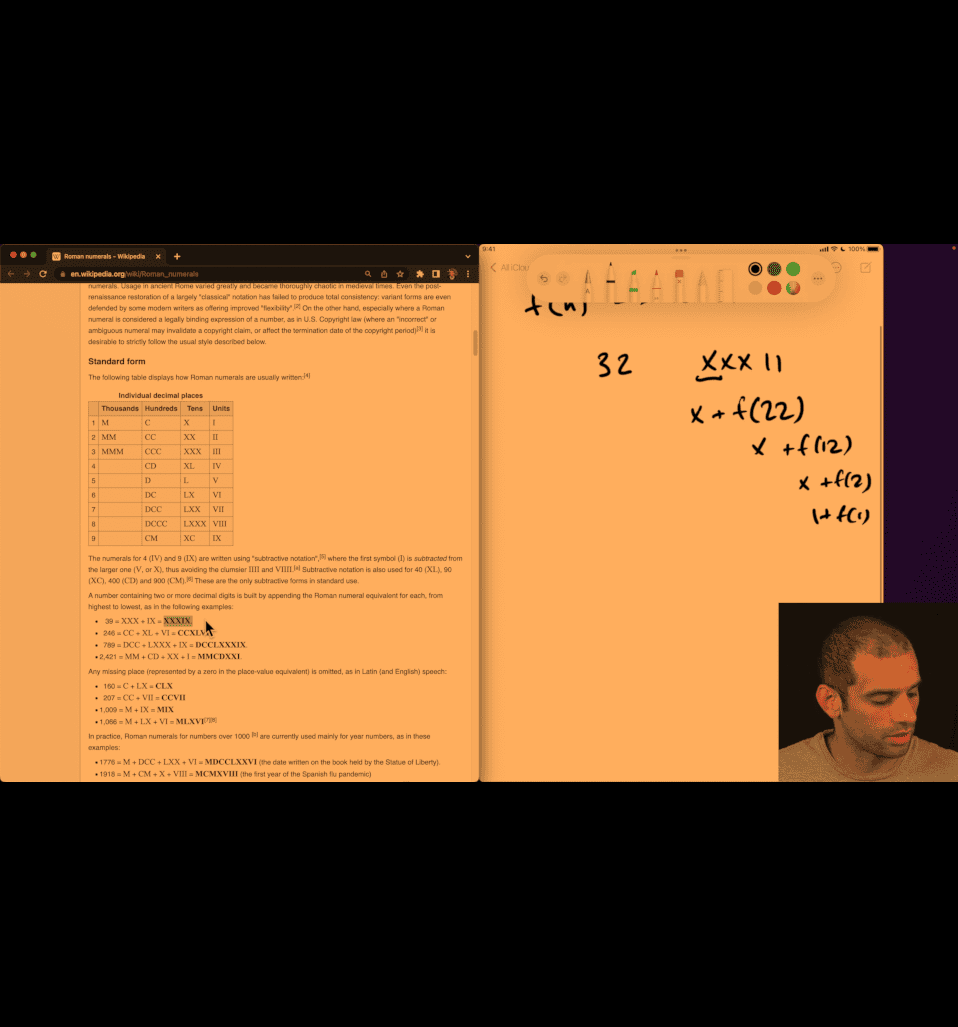
recursively → substract the larger problem → smaller
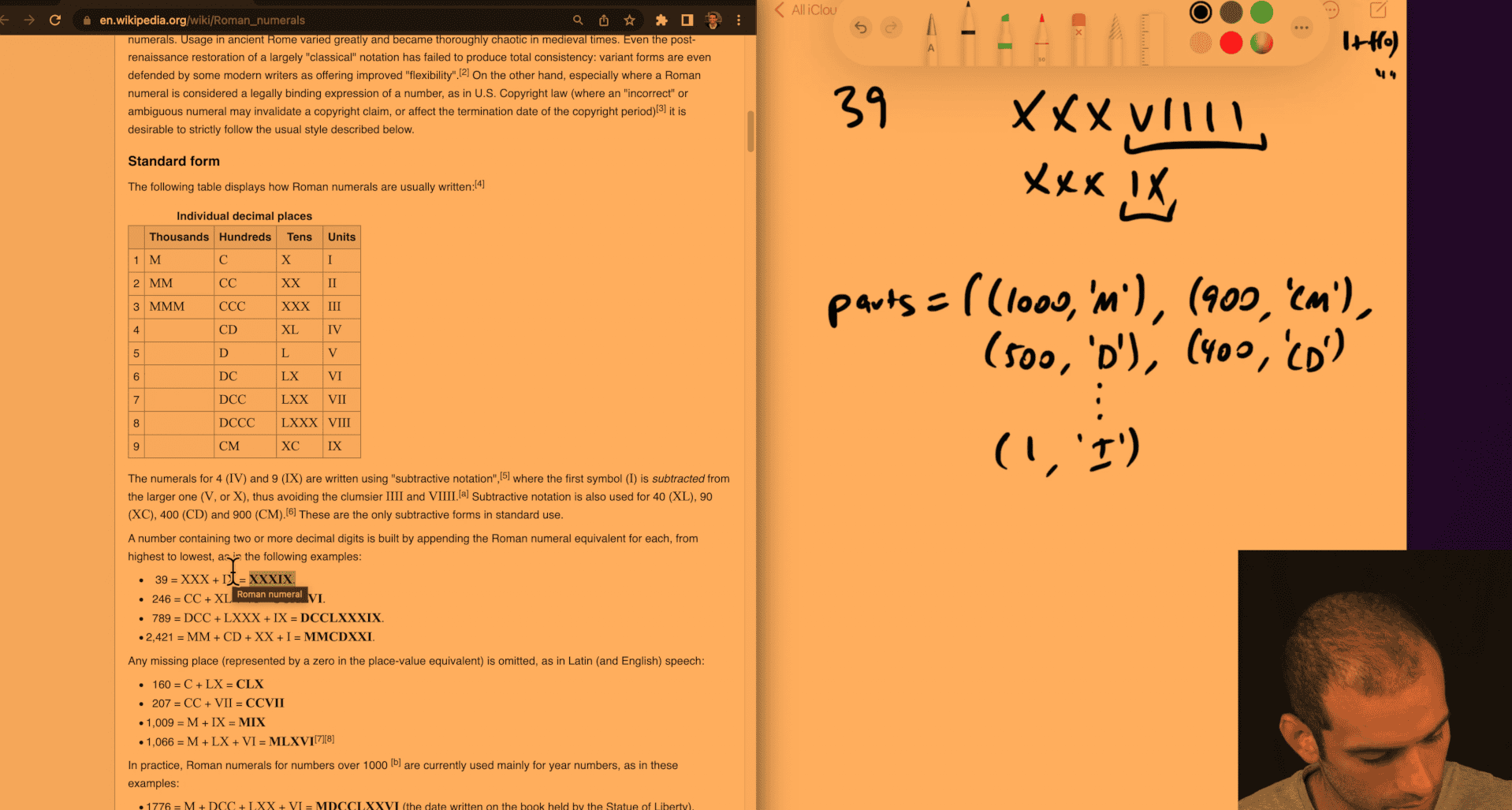
scratch and keep planing:
def f(n):
  for d,r:
    if d<=n:
      return r+f(n-d)
  return ""
parts = [
    (1000, "M"),
    (900, "CM"),
    (500, "D"),
    (400, "CD"),
    (100, "C"),
    (90, "XC"),
    (50, "L"),
    (40, "XL"),
    (10, "X"),
    (9, "IX"),
    (5, "V"),
    (4, "IV"),
    (1, "I"),
]


def f(n):
    if n <= 0:
        return ""
    for d, r in parts:
        if d <= n:
            return r + f(n - d)
    return ""

if __name__ == "__main__":
    cases = ((39, "XXXIX"), (2421, "MMCDXXI"), (1066, "MLXVI"))
    for n, x in cases:
        assert f(n) == x
    print("ok")
more overkill feature:
binary search bisect
from bisect import bisect_right

values = [1, 4, 5, 9, 10, 40, 50, 90, 100, 400, 500, 900, 1000]
symbols = ["I", "IV", "V", "IX", "X", "XL", "L", "XC", "C", "CD", "D", "CM", "M"]


def f(n):
    r = ""
    while n > 0:
        i = bisect_right(values, n) - 1  # largest value <= n
        r += symbols[i]
        n -= values[i]
    return r
003 Correct binary search.mp4
from typing import List, Optional

def binsearch(nums: List[int], target: int) -> Optional[int]:
    lo = 0
    hi = len(nums) - 1
    # Invariant: if target is in nums, then it is within indices [lo, hi]
    while lo <= hi:
        mid = lo + (hi - lo) // 2  # avoids overflow and biases toward lower mid
        value = nums[mid]
        if value == target:
            return mid
        if value < target:
            lo = mid + 1  # target, if present, is in [mid+1, hi]
        else:
            hi = mid - 1  # target, if present, is in [lo, mid-1]
    return None

#if name=main:
a = [-5, -2, 0]
b = [0, 2, 3, 4, 9]

cases = [
    (a, -5, 0),
    (a, -2, 1),
    (a,  0, 2),
    (a,  2, None),
    (a, -3, None),

    (b,  0, 0),
    (b,  3, 2),
    (b,  4, 3),
    (b,  2, 1),
    (b,  9, 4),
]
for nums, n, exp in cases:
    assert binsearch(nums, n) == exp, (nums, n, exp, binsearch(nums, n))
print('ok')
010 The enormous difference between polynomial and exponential.mp4
O(n^2) vs O(2^n)
011 Building an intuition for common running times.mp4
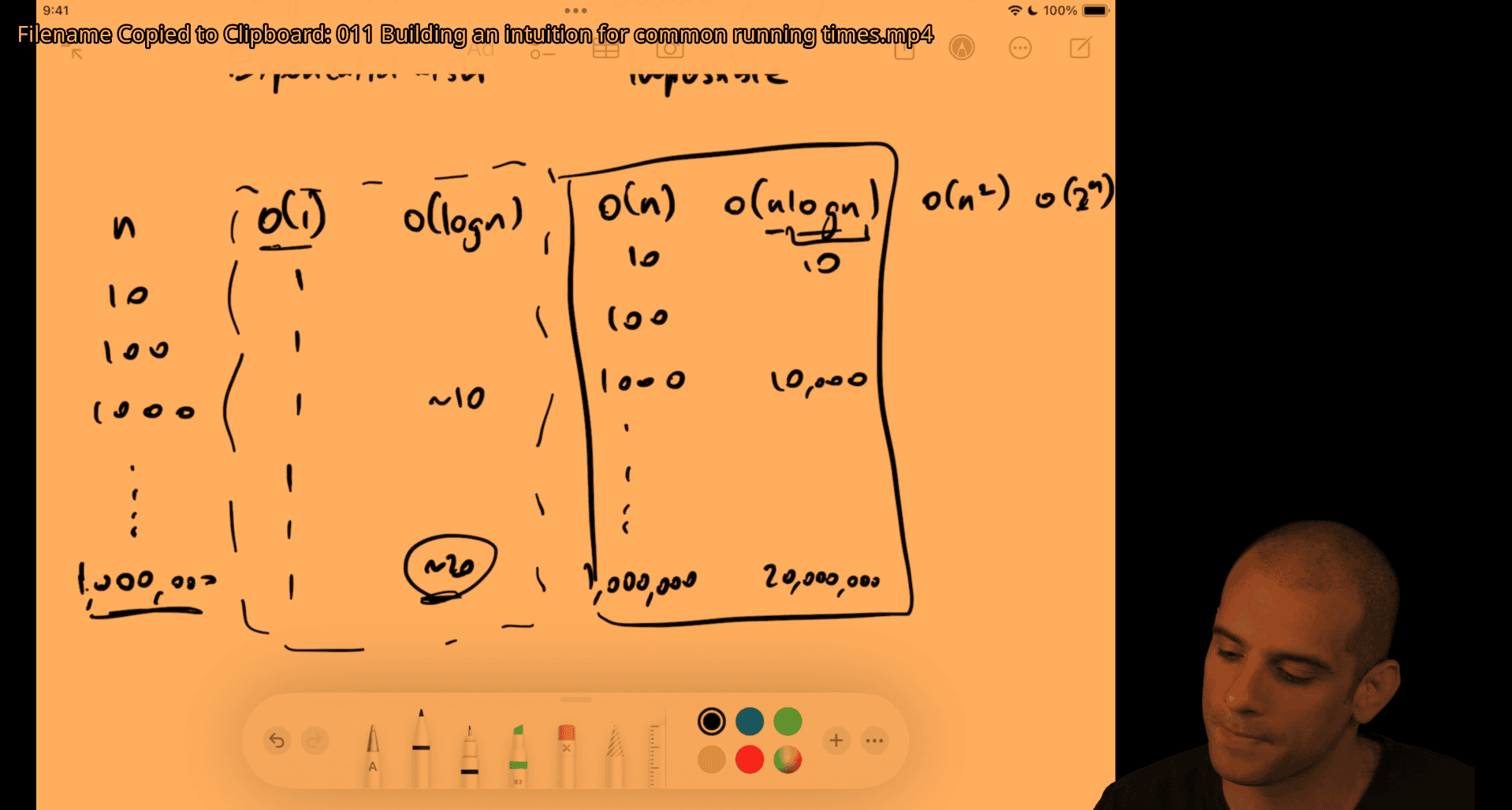
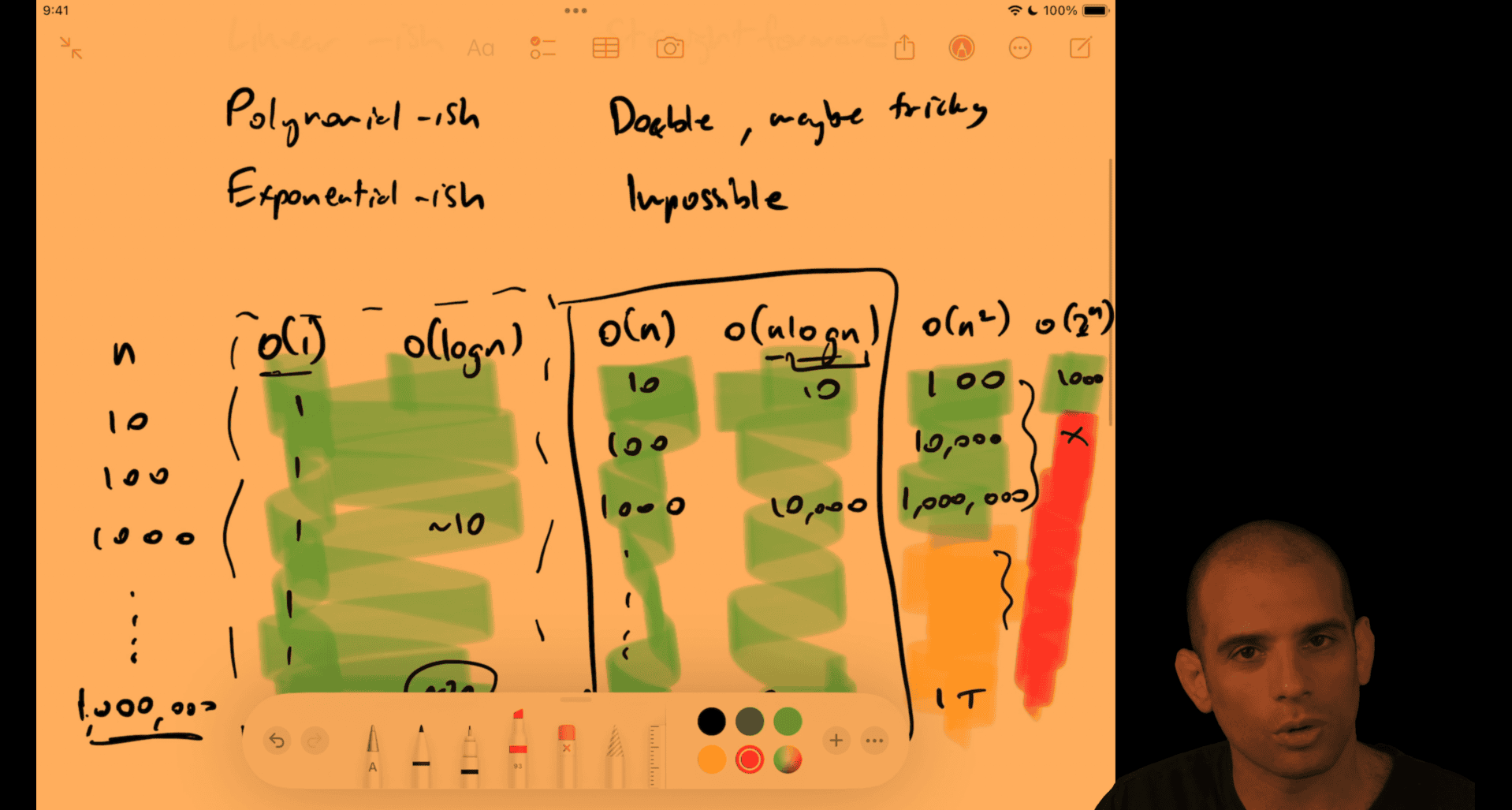
- o(n^2) is ok if n ⇐1000 but not for o(2^n)
006 Finding duplicates
Asymptotic Analysis and Finding Duplicates
Introduction: Asymptotic Analysis as a Tool
The Love-Hate Relationship
- Many engineers have mixed feelings about Big O notation
- Common issues: under-using and over-using it
- It’s one tool in your toolkit, not the only thing
What Asymptotic Analysis Does
Theoretical perspective:
- Allows speaking about trade-offs between approaches
- Agnostic of the specific system running the code
- Enables algorithms from the 1950s to remain relevant today
- Part of a multi-decade (approaching multi-century) conversation about algorithms
Practical reality:
- You cannot be agnostic of your actual system
- Real systems matter: machine, language, data characteristics, RAM constraints
- Some of the most important decisions depend on context
The balance:
- Theory helps us speak generally and universally
- Practice requires considering the actual system
- Both perspectives are necessary
The Problem: Finding Duplicates
Task: Write a function hasDuplicate(array) that returns true if there are duplicate integers in an array, false otherwise.
Three different engineers propose three different approaches.
Solution 1: Nested Loops (Compare Everything)
Approach
- For each element in the array, compare it to every other element
- Can optimize by using symmetry (comparing A to B but not B to A)
Complexity Analysis
Time: O(n²)
- Work grows as the area of a square (n × n)
- Even with symmetry optimization (comparing only half), it’s still fundamentally n²
- Constant factors (like 1/2) don’t change the complexity class
Space: O(1)
- No extra data structures needed
Growth Example
- Going from 10 to 20 elements: 100 → 400 comparisons
- Going from 10 to 100 elements: 100 → 10,000 comparisons
- Substantial growth as n increases
When to Use
- Simple and straightforward
- Good for small, bounded n
- Easy to understand and maintain
- Not ideal for large databases or unbounded growth
Solution 2: Sort Then Check Adjacent Pairs
Approach
- Sort the array (non-destructive or sort a copy)
- Iterate through checking adjacent pairs
- If any adjacent pair is equal, there’s a duplicate
Complexity Analysis
Time: O(n log n)
- Sorting: O(n log n) - this is “astonishing” because most intuitive sorts are O(n²)
- Iteration: O(n)
- Combined: O(n log n) (the n log n term dominates)
Space: O(n) or O(1)
- O(n) if you need to create a copy (non-destructive)
- O(1) if you can sort in-place
Understanding n log n
Key insight: n log n is much closer to linear than to n²
Concrete examples:
- log₂(1024) = 10 (since 2¹⁰ = 1024)
- log₂(1 billion) ≈ 30 (since 2³⁰ ≈ 1 billion)
- The logarithm grows very slowly compared to n
Comparison:
- For 10,000 elements: iteration takes 10,000 units of work
- n log n is substantially better than n² for large n
When to Use
- Better than O(n²) for large n
- May require extra space if sorting in-place isn’t possible
- More complex than nested loops
Solution 3: Hash Map/Set (Single Pass)
Approach
- Iterate through array once
- For each element, check if it’s already in a hash map/set
- If yes → duplicate found
- If no → add it to the hash map/set
Complexity Analysis
Time: O(n)
- Single pass through array: O(n)
- Hash map operations (insert, lookup): O(1) average case
- Combined: O(n)
Space: O(n)
- Must store all elements in the hash map
- Space grows proportionally with input size
Comparison to Solution 2
Theoretically: O(n) is better than O(n log n)
- There exists some n where Solution 3 is definitely faster
Practically:
- Requires O(n) space (Solution 2 might use O(1) if in-place)
- May not be feasible if RAM is constrained
- More complex than Solution 1
When to Use
- Best theoretical time complexity
- Requires extra space
- Consider: Do we have enough RAM? Is n large enough that the difference matters?
Key Insights About Asymptotic Analysis
What It Discards
-
Constant factors
- O(n²) vs O(½n²) are the same complexity class
- The 1/2 optimization doesn’t change the analysis
-
Non-dominant terms
- O(n log n + n) = O(n log n)
- The +n term is dominated by n log n
-
Exact counts
- Focus is on pattern of growth, not precise numbers
Complexity Classes That Matter
In practice, only a handful of complexity classes make a meaningful difference:
- Constant: O(1)
- Linear: O(n)
- Logarithmic: O(log n)
- Linearithmic: O(n log n)
- Polynomial: O(n²), O(n³), etc.
- Exponential: O(2ⁿ) - typically intractable
When Theory Meets Practice
Questions to ask:
- At what n does this algorithm become too slow?
- Will our business/database ever reach that n?
- Is the simpler O(n²) code better if it’s more maintainable?
- Can we afford the space for the O(n) solution?
- Is the code maintainable and robust?
Example consideration:
- If checking millions of integers and never trillions
- If O(n²) is fast enough (< 10ms) for your use case
- If simpler code reduces bugs and maintenance cost
- Then: O(n²) might be the right choice
Real-World Application: Database Joins
The three approaches to finding duplicates mirror the three main database join algorithms:
- Nested Loop Join: O(n²) - compare everything to everything
- Sort-Merge Join: O(n log n) - sort then merge
- Hash Join: O(n) - build hash table, probe
This pattern appears in many contexts throughout computer science.
Takeaways
- Asymptotic analysis is a tool, not the only consideration
- Theory enables universal conversation about algorithms across decades
- Practice requires system-specific thinking - machine, data, constraints
- Simple code can be better if n is bounded and maintainability matters
- Know when each approach is best:
- Small n, simple code → O(n²) might be fine
- Large n, space available → O(n) hash approach
- Large n, space constrained → O(n log n) sort approach
- Be able to articulate trade-offs in both theoretical and practical terms
- This pattern (nested loops, sort, hash) appears everywhere - recognizing it is valuable
Practice Questions
- Beginner: Which approach do you prefer and why?
- Intermediate: When would you prefer each approach over the others?
- Advanced: Find a clear circumstance where each of the three is better than the other two
Notes on Notation
- The speaker uses “O of n” notation but notes that formal Big O definition will be covered separately
- Focus here is on intuitive understanding of growth patterns
- Complexity classes will be covered in more detail in future videos
007 Fizzbuzz sum.mp4
Critical question: Do I need to look at every element?
- If yes (e.g., printing FizzBuzz for each number): You’re stuck at O(n)
- If no (e.g., just need the sum): Look for mathematical patterns or closed-form solutions
Within complexity class: You can still optimize constant factors, but for substantial improvement, you need a different complexity class.
with divide and conquer, asking yourself, is there a log time solution to this, would be like saying, could I purchase with divide and conquer, where I divide this into two or more pieces, solve these problems in a way where I can combine the results ?
- the first way that you might want to think about this, you want to try and find a pattern, right, where we can have a mathematical expression for computing that pattern, and so you might
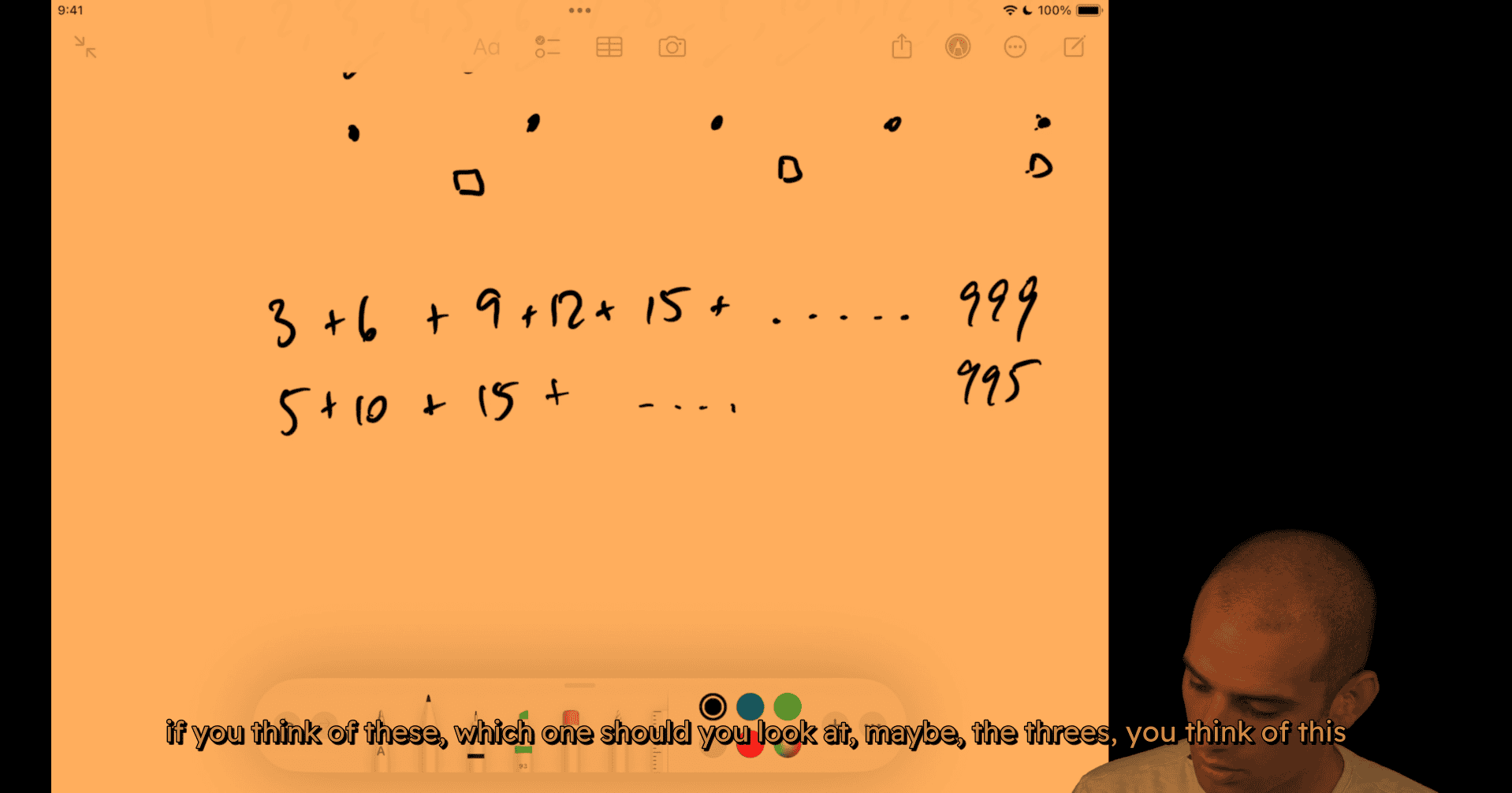
any faster way , pattern?
deduct the repeated part (15 common divider for 3 and 5)
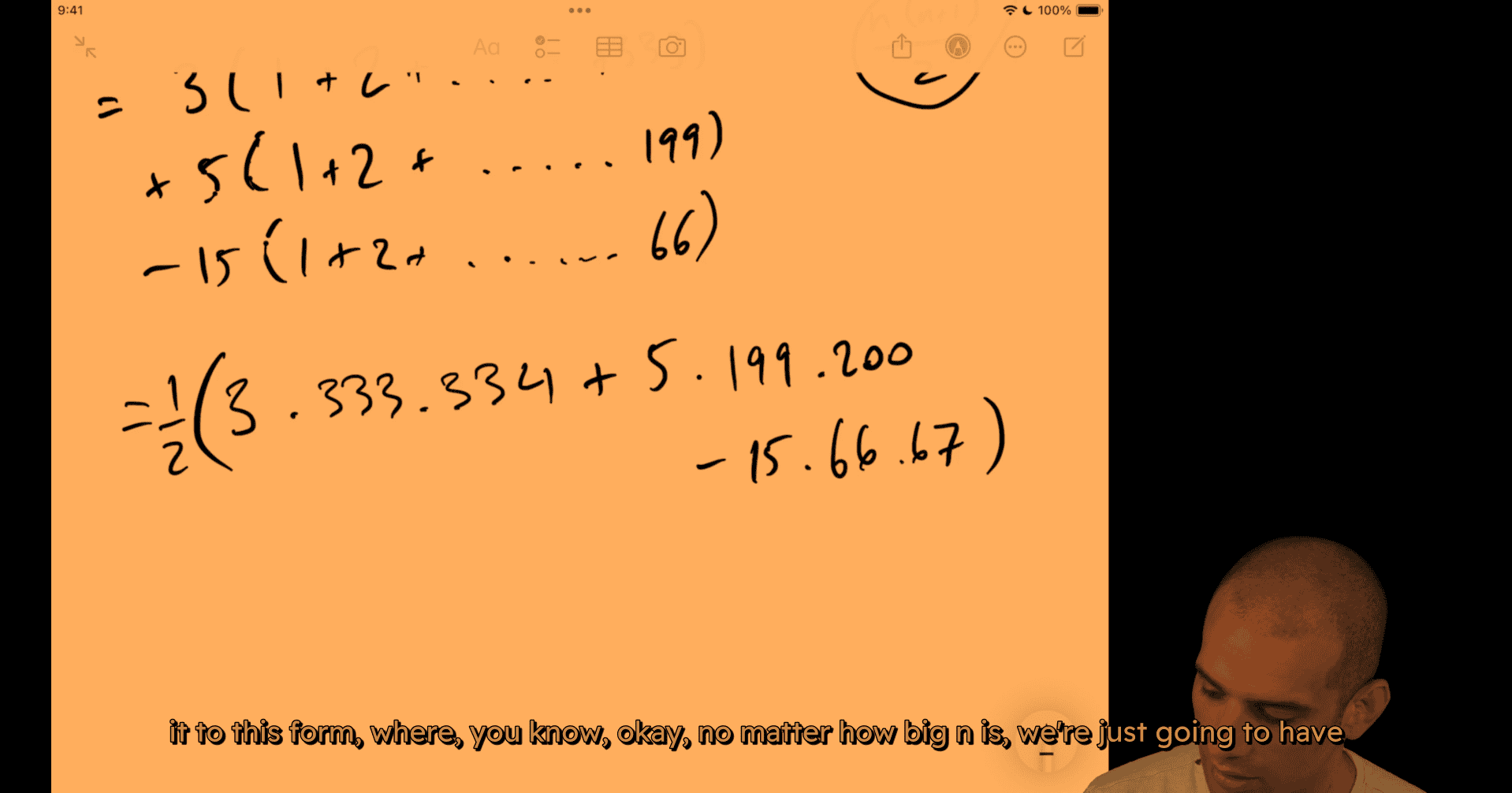
a few multiplications and a few addition subtractions divided by 2, right, n could be billions, constant time solutions
008 Just iterate.mp4
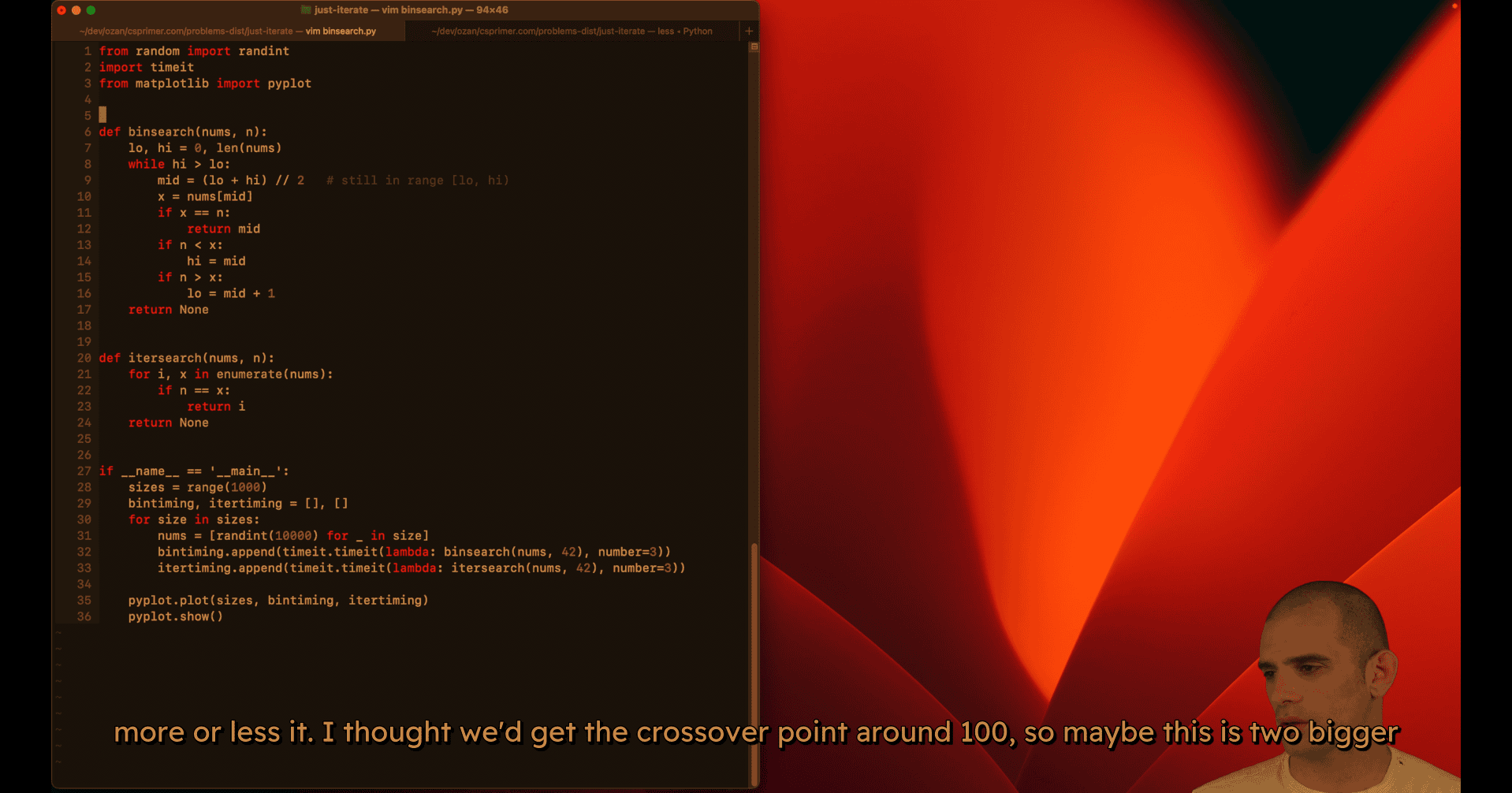
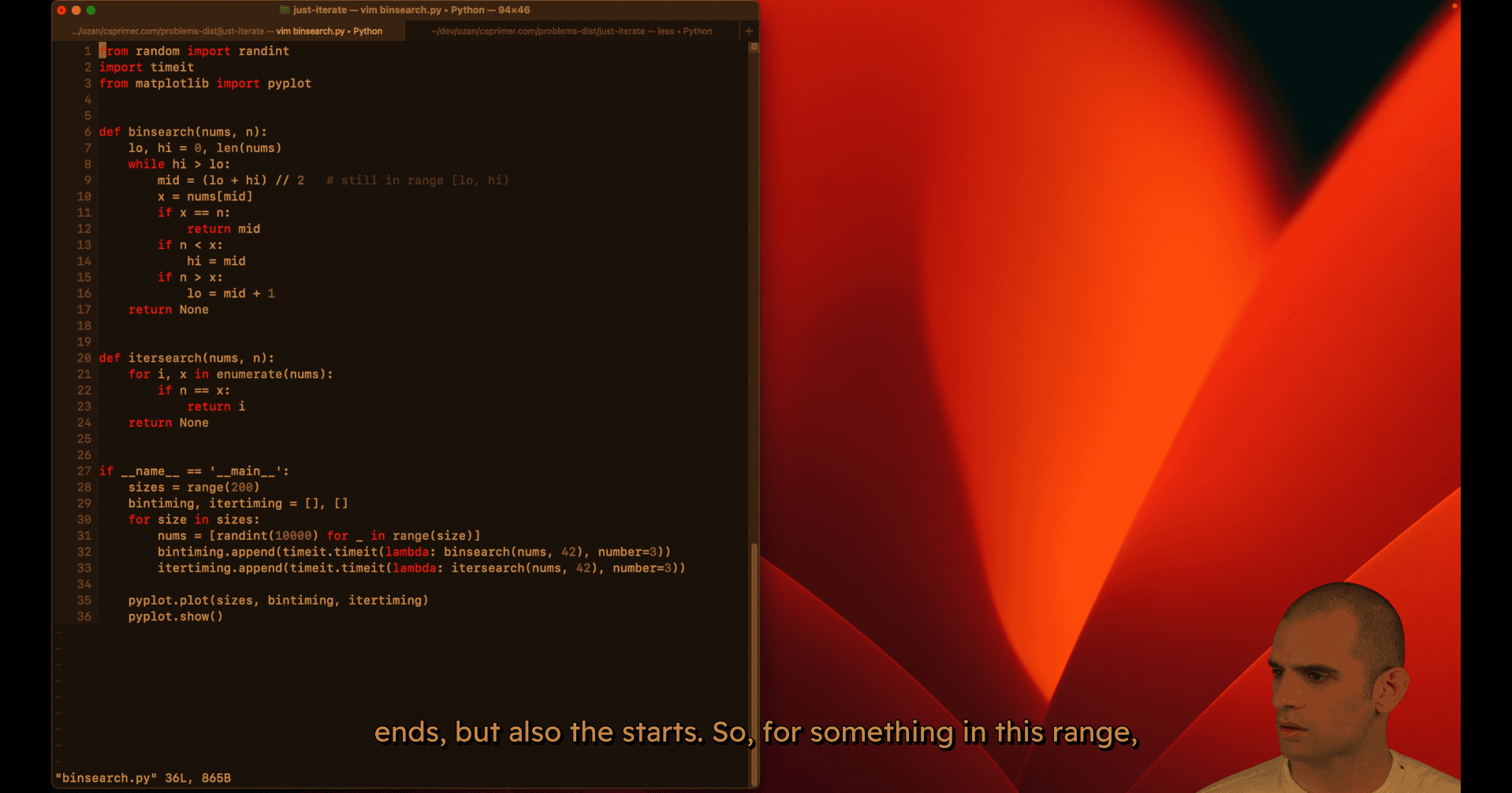
from random import randint
import timeit
from matplotlib import pyplot

def binsearch(nums, n):
    lo = 0
    hi = len(nums)
    while hi > lo:
        mid = (lo + hi) // 2  # still in range [lo, hi)
        x = nums[mid]
        if x == n:
            return mid
        if n < x:
            hi = mid
        else:
            lo = mid + 1
    return None

def itersearch(nums, n):
    for i, x in enumerate(nums):
        if n == x:
            return i
    return None

if __name__ == '__main__':
    sizes = range(200)
    bintiming, itertiming = [], []
    for size in sizes:
        nums = [randint(0, 10000) for _ in range(size)]
        bintiming.append(timeit.timeit(lambda: binsearch(nums, 42), number=3))
        itertiming.append(timeit.timeit(lambda: itersearch(nums, 42), number=3))
    pyplot.plot(sizes, bintiming, itertiming)
    pyplot.show()
009 Analysis practice.mp4
i just skip the video
- Problem: Cut a 3×3×3 cube into 27 unit cubes with minimum cuts
Asymptotic Analysis: Comprehensive Study Notes
Introduction: The Goal of Asymptotic Analysis
Purpose
- Primary goal: Assess the time and space cost, in Big O terms, of most programs you’ll encounter
- Enable comparison of algorithms in a hardware-agnostic way
- Provide a universal language to discuss algorithms across different systems and contexts
- Balance theoretical understanding with practical systems considerations
The Balance: Theory vs. Practice
Theoretical perspective:
- Allows us to say “this algorithm from the 50s is good” in a universal way
- Makes sense regardless of what machine it’s running on
- Enables conversation about algorithms independent of hardware
Practical reality:
- Cannot ignore hardware, data characteristics, or context
- Cannot ignore maintainability of code
- Need both theoretical and systems understanding
The goal: Be comfortable enough with analysis to proceed to graph search, divide-and-conquer, dynamic programming, and extend analysis techniques to those algorithms.
Core Definition: When Is One Algorithm Better?
The Fundamental Question
Given two algorithms, can we say one is objectively better than the other?
Answer: Yes, if there exists some n where one algorithm definitely outperforms the other, regardless of:
- Constant factors
- Hardware differences (Raspberry Pi vs. supercomputer)
- Boot-up time or initialization overhead
Example
- Algorithm A: Linear time (O(n)) on a slow Raspberry Pi
- Algorithm B: Quadratic time (O(n²)) on a supercomputer
Question: Is A better than B?
Answer: Yes! There exists some n where the linear algorithm on the Raspberry Pi will beat the quadratic algorithm on the supercomputer. Eventually, the growth rate dominates.
Key Insight
- Not for every n, but for some n
- Constant factors don’t matter in the limit
- Hardware differences don’t matter in the limit
- The growth pattern (linear vs. quadratic) is what matters
Complexity Classes: The Four Practical Groups
1. Constant-ish
- O(1): Constant time
- O(log n): Logarithmic time
- O(√n): Square root time
Characteristics:
- Effectively “free” or very cheap
- Log n grows extremely slowly (log₂(1000) ≈ 10, log₂(1M) ≈ 20, log₂(1B) ≈ 30)
- Practical systems perspective: these are all “constant-ish”
2. Linear-ish
- O(n): Linear time
- O(n log n): Linearithmic time
Characteristics:
- Scale horizontally: “for every dollar we make, add another server”
- Generally manageable for most applications
- n log n is much closer to linear than to quadratic
3. Polynomial
- O(n²): Quadratic time
- O(n³): Cubic time
- O(nᵏ): Polynomial time for any constant k
Characteristics:
- May need clever optimizations at scale
- At Google scale, might not be affordable
- Generally workable but requires careful consideration
4. Non-Polynomial (Hard Problems)
- O(2ⁿ): Exponential time
- O(n!): Factorial time
Characteristics:
- Effectively impossible for meaningful n
- For exponential: 2⁵⁰ is already intractable
- Cannot use such algorithms in practice
Practical Framing
The four groups help answer:
- Is it effectively free? → Constant-ish
- Can we scale horizontally? → Linear-ish
- Do we need clever optimizations? → Polynomial
- Is it impossible? → Non-polynomial
Units of Measurement
Time Complexity
Unit: Operations
- Could be CPU cycles, seconds, or any consistent unit
- When constant factors are discarded, the exact unit doesn’t matter
- Assumption: Each operation takes consistent time (not always true for big integers, user-defined types, etc.)
Example: Counting function calls
- If each function call takes the same time regardless of input
- Then counting function calls is a valid proxy for time
- Hazard: If function call time varies with input, need to be more careful
Space Complexity
Unit: Memory units
- Could be bytes, stack frames, pages, disk blocks
- Need a consistent unit that grows predictably
Common units:
- Stack frames: For recursive functions, each call uses one stack frame
- Array elements: For data structures, count elements stored
- Bytes: For raw memory usage
Example: Stack space
- Each recursive call pushes a stack frame
- Stack frame size is consistent (contains function locals, return address, etc.)
- Can count stack frames as units of space
Example 1: Constant Time Operations
Simple Multiplication
def multiply(a, b):
    return a * b
Time Complexity: O(1)
- One operation (multiplication)
- Irrespective of input size
Assumptions:
- Integers are primitive types (fit in CPU registers)
- Multiplication is a single CPU instruction
- Not Python big integers (arbitrarily sized)
- Not user-defined types with custom
__mul__methods
When assumptions break:
- Python big integers: multiplication time grows with number size
- Cryptographic operations: multiplying huge primes is not constant
- User-defined types:
__mul__could do anything
Key takeaway: Always consider what assumptions you’re making about input types and operations.
Example 2: Square Root Functions
Built-in Square Root
import math
def sqrt_builtin(n):
    return math.sqrt(n)
Time Complexity: Depends on implementation
- If hardware floating-point: O(1) - constant time
- If software implementation: Could be O(log n) or O(√n)
Binary Search Square Root
def sqrt_binary_search(n):
    # Binary search for k such that k² ≤ n < (k+1)²
    left, right = 1, n
    while left < right:
        mid = (left + right) // 2
        if mid * mid <= n:
            left = mid + 1
        else:
            right = mid
    return left - 1
Time Complexity: O(log n)
- Binary search over space from 1 to n
- Each iteration halves the search space
Linear Search Square Root
def sqrt_linear(n):
    k = 1
    while k * k <= n:
        k += 1
    return k - 1
Time Complexity: O(√n)
- Tries 1², 2², 3², … until finding the answer
- Terminates early at √n iterations
Comparison: O(log n) vs. O(√n)
Theoretical: O(log n) is better (lower complexity class)
Practical considerations:
- Constant factors: Binary search has branch prediction overhead
- Threshold: At n = 64, √64 = 8, log₂(64) = 6
- Real systems: May need to benchmark to determine which is actually faster
- Interview perspective: Want to hear about systems considerations, not just “I’d benchmark”
Key insight: Sometimes O(log n) vs. O(√n) are close enough that constant factors and systems considerations matter more than the theoretical difference.
Example 3: Factorial - Recursive vs. Iterative
Recursive Factorial
def factorial_recursive(n):
    if n <= 1:
        return 1
    return n * factorial_recursive(n - 1)
Time Complexity: O(n)
- Makes n function calls (n, n-1, n-2, …, 1)
- Each call does one multiplication
- Total: n multiplications
Space Complexity: O(n)
- Each recursive call uses one stack frame
- Maximum stack depth: n
- Total: n stack frames
Call chain: Linear chain, not a tree
- factorial(10) → factorial(9) → factorial(8) → … → factorial(1)
- Just a straight line, not branching
Iterative Factorial
def factorial_iterative(n):
    result = 1
    for i in range(1, n + 1):
        result *= i
    return result
Time Complexity: O(n)
- Loop runs n times
- Each iteration: one multiplication
- Total: n multiplications
Space Complexity: O(1)
- Only one accumulator variable
- No stack frames
- Constant space
Comparison
Time: Both O(n) - same asymptotic complexity
Space:
- Recursive: O(n) - stack frames
- Iterative: O(1) - constant space
Practical speed: Iterative is typically faster
- No function call overhead
- No stack frame allocation
- But both are O(n), so this is just a constant factor difference
Tail Call Optimization
What Is Tail Call Optimization?
Tail position: The very last operation in a function, with nothing after it
Tail call: A recursive call in tail position
Tail call optimization (TCO): Compiler/interpreter optimization that converts tail-recursive functions to iterative form automatically
Example: Non-Tail Recursive
def factorial_recursive(n):
    if n <= 1:
        return 1
    return n * factorial_recursive(n - 1)  # NOT tail position
Why not tail?: After the recursive call returns, we still need to multiply by n
Converting to Tail Recursive
def factorial_tail_recursive(n, accumulator=1):
    if n <= 1:
        return accumulator
    return factorial_tail_recursive(n - 1, n * accumulator)  # Tail position
Now it’s tail recursive: The recursive call is the very last thing, nothing happens after it
Benefits of TCO
- Space: O(n) → O(1) (no stack frames needed)
- Speed: Eliminates function call overhead
- Automatic: Compiler/interpreter handles the conversion
Languages with TCO
- LISP: Heavily recursive, TCO is standard
- JavaScript: V8 and other engines support TCO (but not in spec)
- Python: Does NOT support TCO (by design choice)
Key insight: If you can write tail-recursive code, TCO can give you the benefits of iteration (O(1) space) while keeping recursive code structure.
Example 4: Fibonacci - Multiple Approaches
Naive Recursive Fibonacci
def fib_naive(n):
    if n <= 1:
        return n
    return fib_naive(n - 1) + fib_naive(n - 2)
Time Complexity: O(2ⁿ)
- Tree structure: Each call branches into two subproblems
- Height: Approximately n (from n down to base cases)
- Branching factor: 2 (each node has 2 children)
- Total nodes: Approximately 2ⁿ
- Tighter bound exists: But O(2ⁿ) is a valid upper bound
Why exponential?
- fib(10) calls fib(9) and fib(8)
- fib(9) calls fib(8) and fib(7)
- fib(8) is computed twice (once from fib(10), once from fib(9))
- Massive redundant computation
Space Complexity: O(n)
- Stack depth: Maximum depth is n (one path from root to leaf)
- Not O(2ⁿ): Stack shrinks and grows, never exceeds n
- Even though we make 2ⁿ function calls, we don’t need 2ⁿ stack frames simultaneously
Memoized Fibonacci
def fib_memoized(n, memo={}):
    if n in memo:
        return memo[n]
    if n <= 1:
        return n
    memo[n] = fib_memoized(n - 1, memo) + fib_memoized(n - 2, memo)
    return memo[n]
Time Complexity: O(n)
- Unique subproblems: Only n unique values (0, 1, 2, …, n)
- Each computed once: After first computation, cached result is reused
- Total work: n function calls, each doing O(1) work (after memoization)
Space Complexity: O(n)
- Memo cache: Stores n values (0 through n)
- Stack depth: Still O(n) maximum
- Total: O(n) space
Key insight: Memoization eliminates redundant subproblem computation by caching results.
Bottom-Up Dynamic Programming
def fib_bottom_up(n):
    if n <= 1:
        return n
    a, b = 0, 1
    for i in range(2, n + 1):
        a, b = b, a + b
    return b
Time Complexity: O(n)
- Loop runs n-1 times
- Each iteration: constant work (addition, assignment)
- Total: O(n)
Space Complexity: O(1)
- Key insight: Only need the last two values
- State: Two integers (a and b)
- No array needed: Don’t need to store all previous values
- No stack: Iterative, not recursive
Comparison to memoized:
- Time: Both O(n) - same
- Space: Bottom-up is O(1) vs. O(n) for memoized
- Why better?: Recognized that only recent state (last 2 values) is needed
The Progression
- Naive recursive: O(2ⁿ) time, O(n) space - exponential, unusable
- Memoized: O(n) time, O(n) space - linear, much better
- Bottom-up: O(n) time, O(1) space - optimal for this problem
Key lesson: After fixing time complexity, can often optimize space by recognizing what state is actually needed.
Practical Considerations
When Constant Factors Matter
Examples:
- Branch prediction: Binary search has unpredictable branches
- Function call overhead: Recursive calls have overhead
- Cache locality: Array access patterns affect performance
- Memory allocation: Dynamic allocation has overhead
When to benchmark:
- Complexity classes are close (e.g., O(log n) vs. O(√n))
- Constant factors might dominate for your n
- Need to understand systems-level behavior
Not enough to just benchmark: Need to understand why one might be faster/slower to validate your benchmark.
Making Assumptions
Always need to state assumptions:
- Input types (integers, not big integers)
- Operation costs (multiplication is constant)
- System characteristics (stack frame size, etc.)
When assumptions break:
- Python big integers: operations grow with size
- User-defined types: could have arbitrary behavior
- Dynamic languages: types unknown until runtime
Key: Be explicit about assumptions, especially in interviews or documentation.
Industry Usage
Common vocabulary:
- “This is O(n²)” - frequently used
- “Polynomial time solution” - used
- “Exponential, can’t use this” - used
Rarely used:
- Θ (theta) - tight bound notation
- Ω (omega) - lower bound notation
- o (little-o) - strict upper bound
- Formal mathematical definitions
Practical focus: Big O for upper bounds, complexity classes, and trade-off discussions.
Common Use Cases
Database operations:
- Join algorithms: nested loop (O(n²)) vs. hash join (O(n)) vs. sort-merge (O(n log n))
- Index selection: affects query complexity
- Query optimization: choosing algorithms based on data size
Data processing:
- GraphQL resolvers: combining data from multiple sources
- ETL pipelines: processing large datasets
- Real-time systems: latency requirements
Key question: At what scale does this algorithm become too slow?
Key Takeaways
1. Asymptotic Analysis Is a Tool
- One tool in your toolkit, not the only consideration
- Enables universal conversation about algorithms
- Must be balanced with systems knowledge
2. The Core Definition
- Algorithm A is better than B if there exists some n where A outperforms B
- Constant factors and hardware don’t matter in the limit
- Growth pattern (linear, quadratic, exponential) is what matters
3. Complexity Classes
- Constant-ish: O(1), O(log n), O(√n) - effectively free
- Linear-ish: O(n), O(n log n) - scale horizontally
- Polynomial: O(n²), O(n³) - may need optimization
- Non-polynomial: O(2ⁿ), O(n!) - effectively impossible
4. Units Matter
- Time: Operations (CPU cycles, function calls, etc.)
- Space: Memory units (stack frames, array elements, bytes)
- Need consistent units that grow predictably
5. Optimization Strategies
- Memoization: Cache subproblem results → reduces redundant computation
- Bottom-up DP: Build solutions iteratively, recognize minimal state needed
- Tail call optimization: Convert tail-recursive to iterative automatically
6. Practical Balance
- Theory enables universal discussion
- Practice requires systems knowledge
- Sometimes need to benchmark (especially when complexity classes are close)
- Constant factors matter in real systems
7. Common Patterns
- Recursive → Iterative: Often improves space from O(n) to O(1)
- Naive → Memoized: Eliminates redundant computation
- Memoized → Bottom-up: Can reduce space by recognizing minimal state
Practice Problems
Beginner
- What’s the time and space complexity of a simple loop that sums an array?
- Compare recursive vs. iterative factorial implementations.
- Why is naive Fibonacci O(2ⁿ) but memoized is O(n)?
Intermediate
- Convert a tail-recursive function to iterative form.
- Optimize a memoized solution to use O(1) space when possible.
- Analyze the square root binary search vs. linear search trade-offs.
Advanced
- Find a tighter bound than O(2ⁿ) for naive Fibonacci (hint: consider early termination).
- Implement tail call optimization manually using a trampoline pattern.
- Analyze space complexity of recursive algorithms with branching (when is it O(depth) vs. O(nodes)?)
Additional Notes
The Cube Cutting Problem (Brain Teaser)
- Problem: Cut a 3×3×3 cube into 27 unit cubes with minimum cuts
- Key insight: Consider the innermost cube - it requires 6 cuts (one per face)
- Technique: Simplify by discarding pieces, focus on the piece requiring most work
- Answer: Minimum is 6 cuts (cannot be done in fewer)
Stretch Goals
- Find tighter bounds for Fibonacci (better than O(2ⁿ))
- Analyze when tail call optimization can be applied automatically
- Understand trampoline pattern for manual TCO
Resources for Further Study
- Donald Knuth’s “The Art of Computer Programming”
- Formal definitions of Big O, Θ, Ω notation
- Systems-level performance analysis (branch prediction, cache locality)
- Compiler optimizations (TCO, inlining, etc.)
015 Parenthesis match.mp4
So, queues are intuitive like that, hopefully you’re processing things in order. buffer, you can kind of think of that as a queue of bytes.
stack: do the opposite of a queue, which is to process something in the opposite order. we want to work in the order of the things most recently visited as a priority
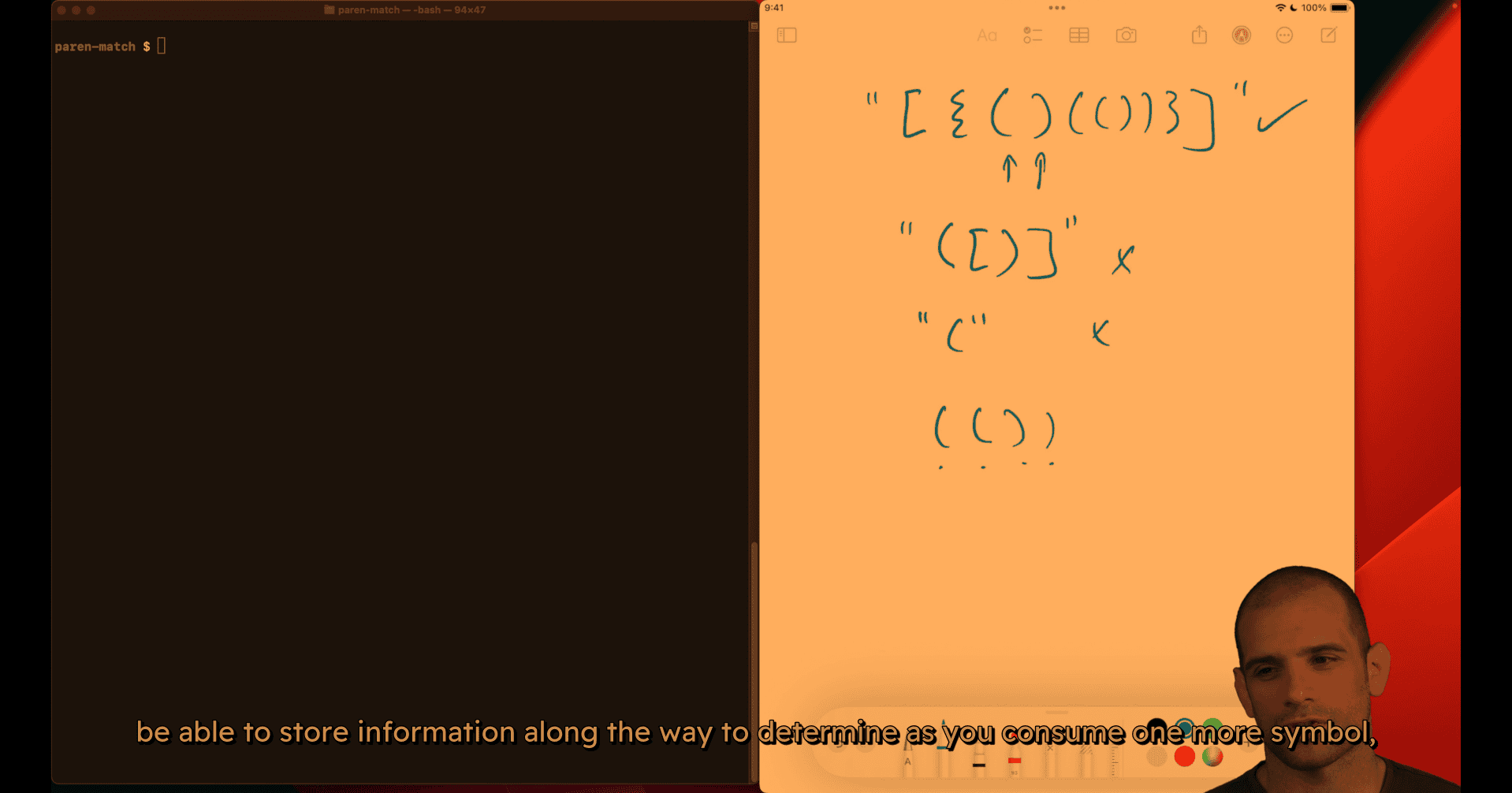
“Do I need to access things in reverse order of when I encountered them?”
If yes → Use a stack!
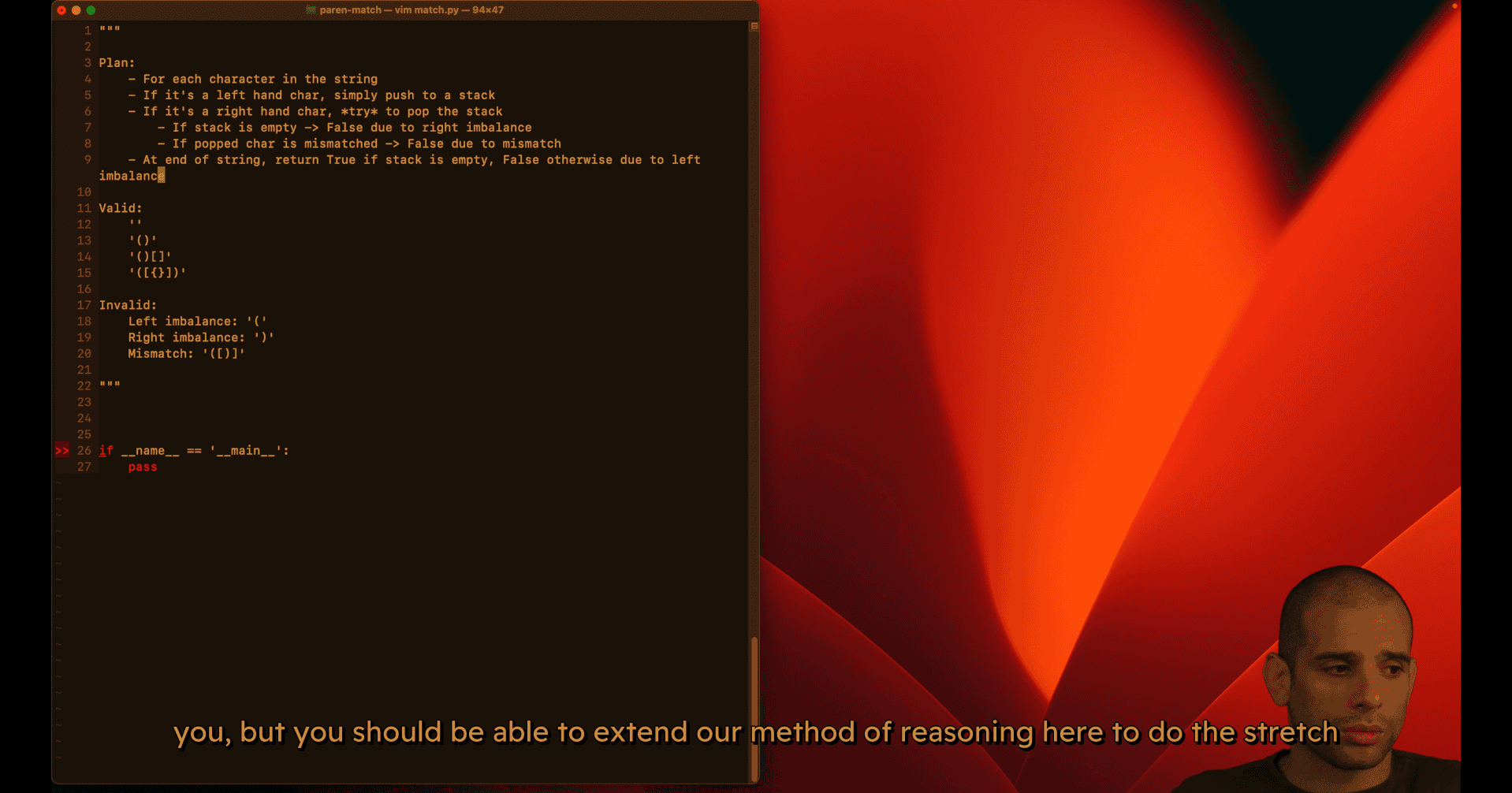
- plan
- small case
primer will state clear the test case , and even name the error case name ‘categorical thinking’
of the reason why this is false. I just like being categorical and having a kind of model type of error and so on in the test cases.
step1 :
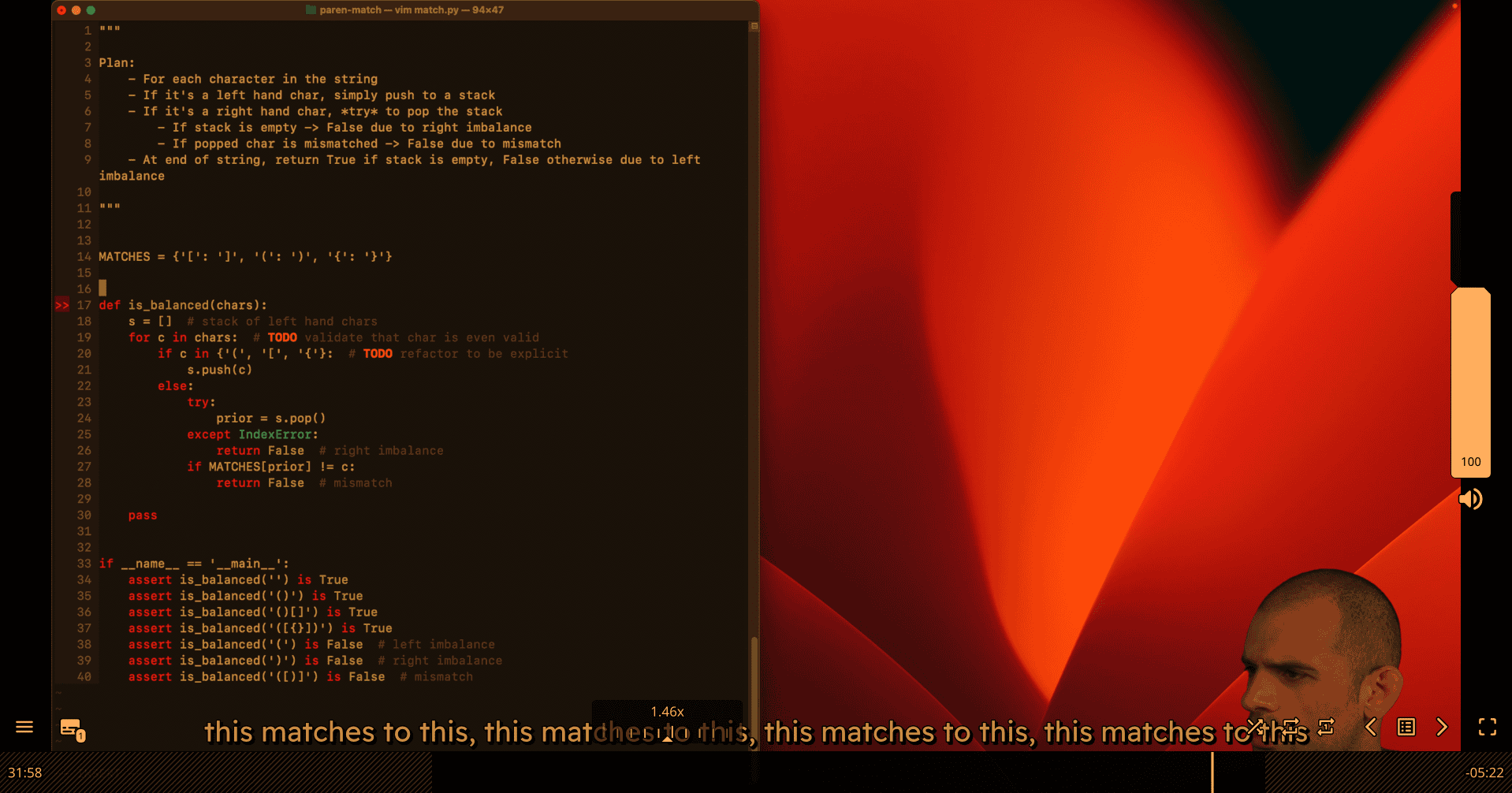
step 2 :
matches left:
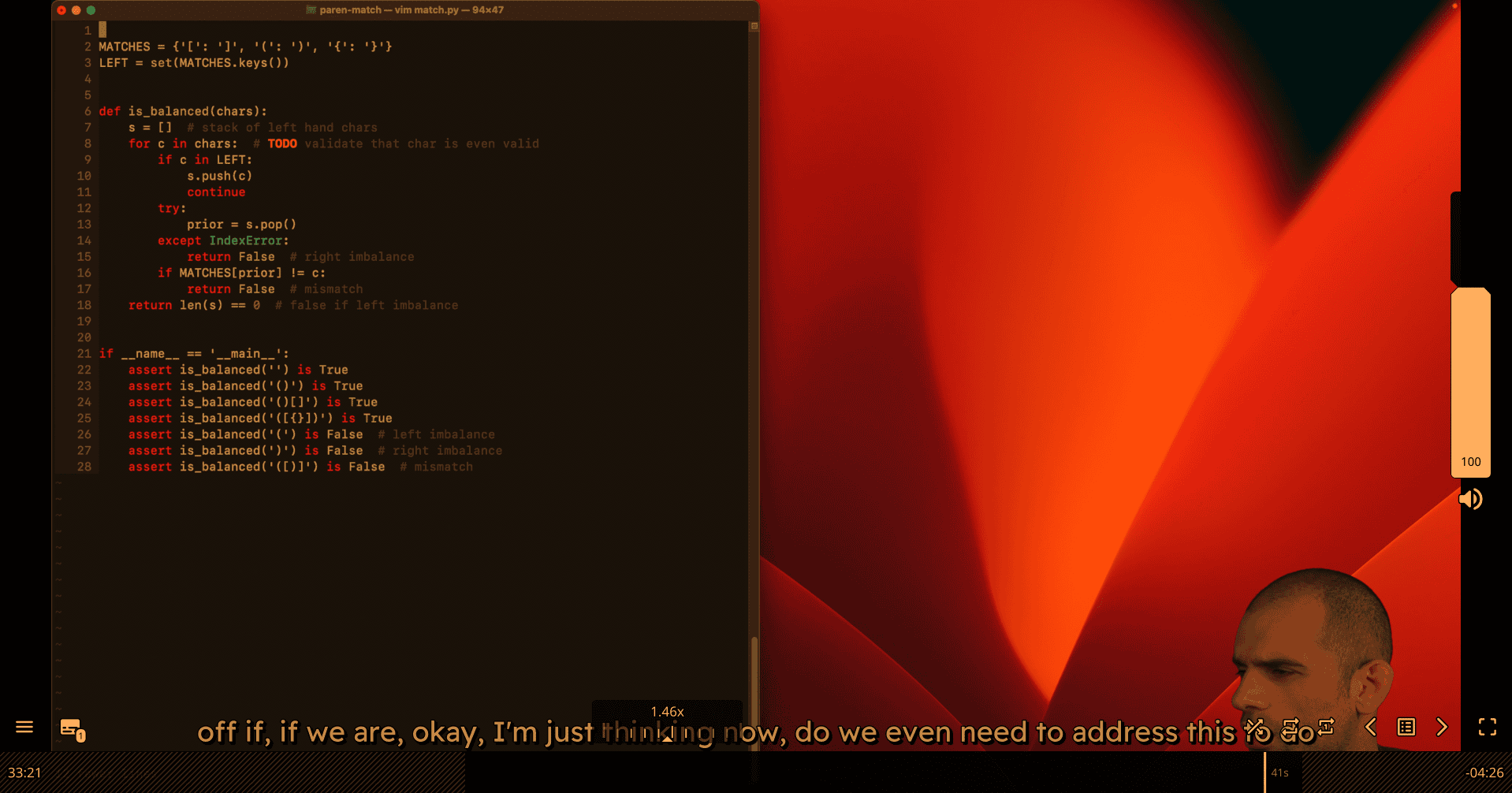 up in our dictionary is not equal to the new value, then we have a mismatch. Maybe actually
"""
Parenthesis Matching Implementation
Based on the algorithm plan from the lecture
"""

MATCHES = {'[': ']', '(': ')', '{': '}'}
LEFT = set(MATCHES.keys())
RIGHT = set(MATCHES.values())

def is_balanced(chars):
    """
    Plan:
    - For each character in the string
    - If it's a left hand char, simply push to a stack
    - If it's a right hand char, *try* to pop the stack
      - If stack is empty -> False due to right imbalance
      - If popped char is mismatched -> False due to mismatch
    - At end of string, return True if stack is empty, False otherwise due to left imbalance
    """
    s = []  # stack of left hand chars
    for c in chars:  # TODO: validate that char is even valid
        if c in LEFT:
            s.append(c)  # Fixed: Python lists use append(), not push()
            continue
        if c not in RIGHT: # Space case
          continue
        try:
            prior = s.pop()
        except IndexError:
            return False  # right imbalance
        if MATCHES[prior] != c:
            return False  # mismatch
    return len(s) == 0  # false if left imbalance


if __name__ == '__main__':
    # Valid cases
    assert is_balanced('') is True
    assert is_balanced('()') is True
    assert is_balanced('()[]{}') is True
    assert is_balanced('({[]})') is True

    # Invalid cases
    assert is_balanced('(') is False  # left imbalance
    assert is_balanced(')') is False  # right imbalance
    assert is_balanced('([)]') is False  # mismatch

    print("All tests passed!")
016 Doubly linked list.mp4
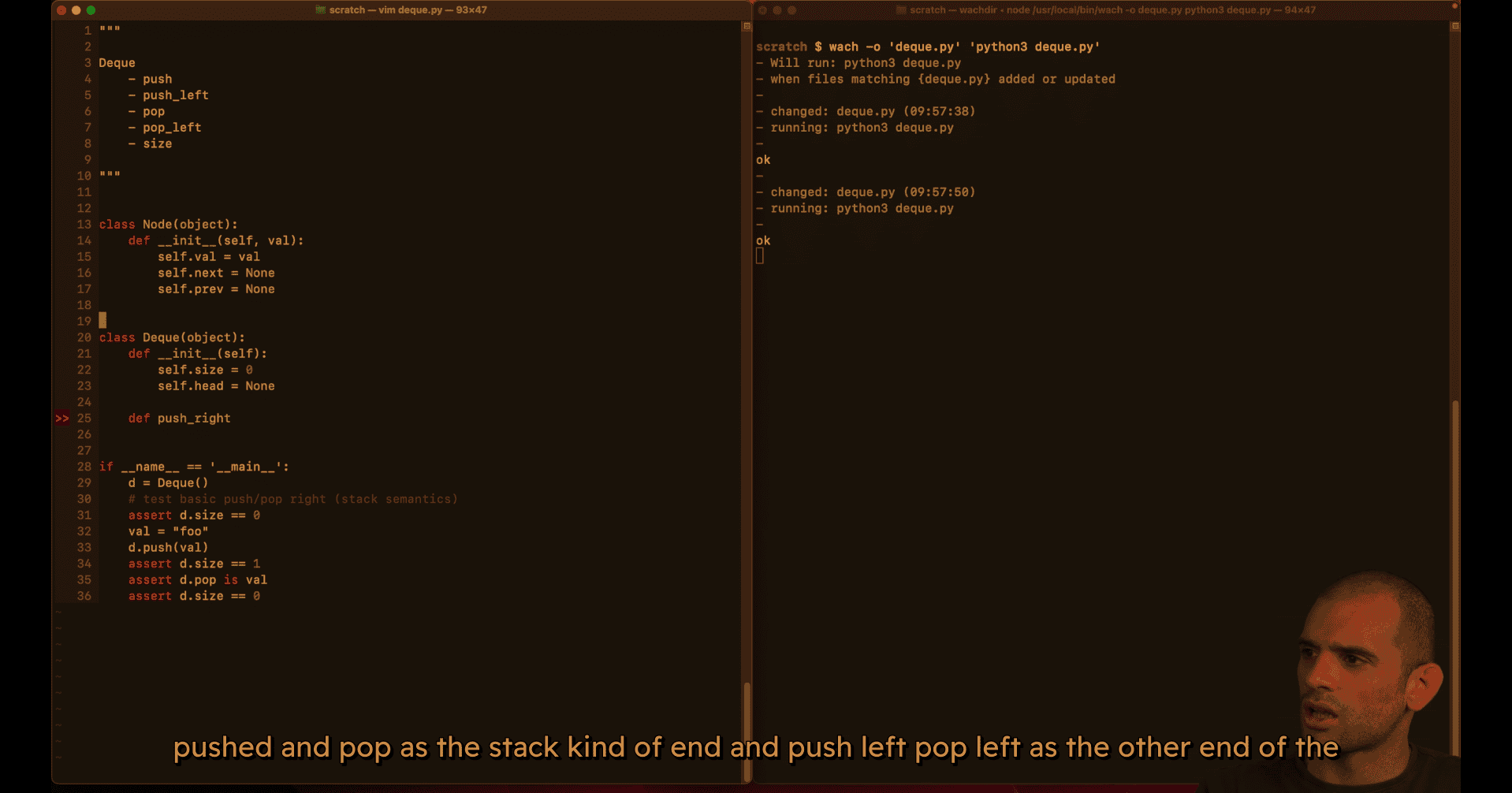
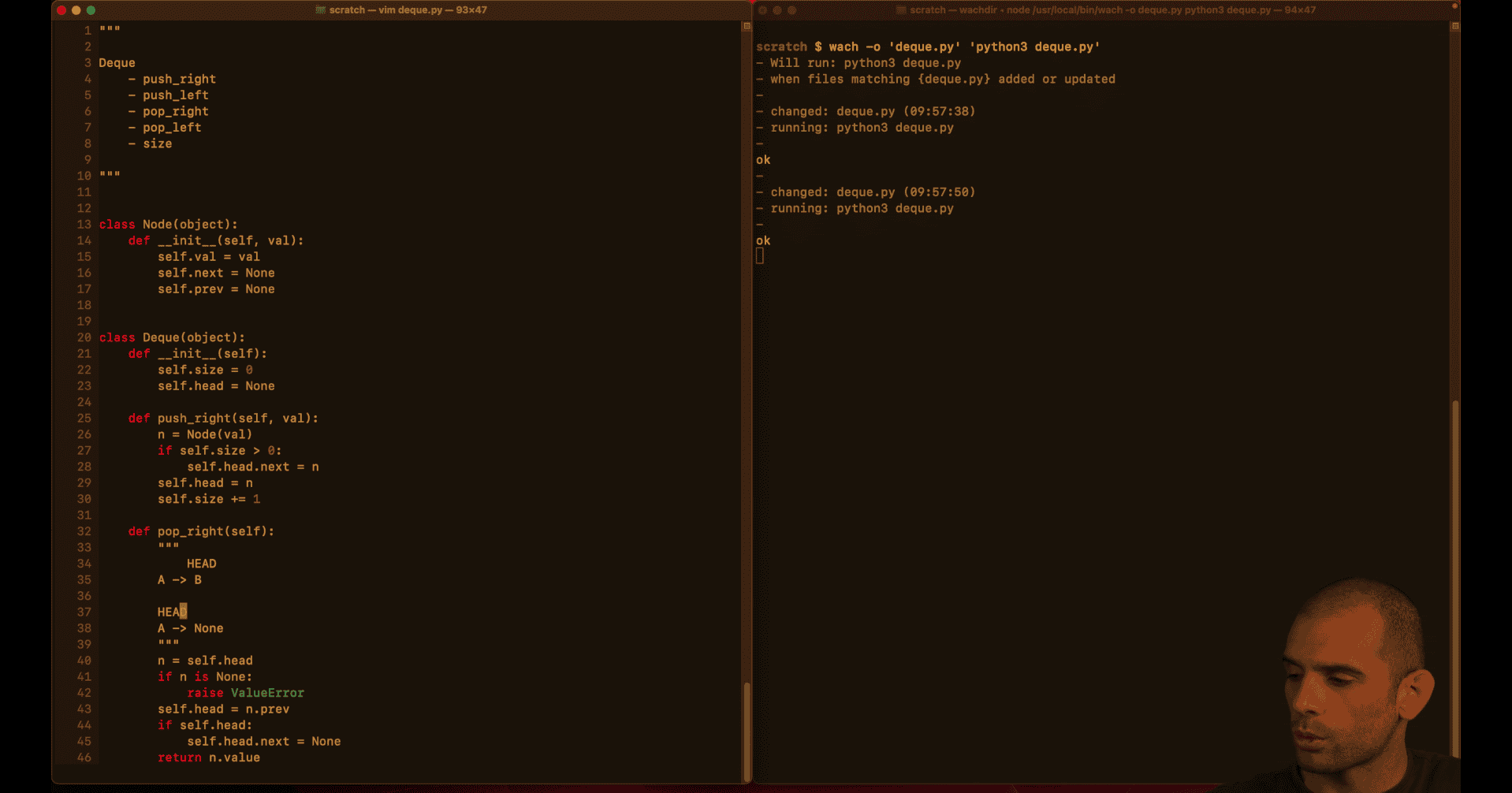
using comment to show the mvp e.g.
double linked list: head become tail, next become prev
- empty case
/home/peter/Desktop/cursor_project/doubly-linked-list-notes.md
Memory Management: Critical Considerations
The Problem: Circular References
Circular reference example:
## Node A points to Node B
A.next = B
B.prev = A

## Even if nothing else references A or B,
## they still reference each other!
## Reference count never drops to zero
In Python:
- Reference counting: Fast, but fails with circular references
- Tracing garbage collection: Slow, but handles circular references
- Best practice: Break references explicitly to avoid circular references
Solution: Always Break Links
When removing a node:
- Set
next = Noneon the node before it - Set
prev = Noneon the node after it - Update head/tail appropriately
- Set head/tail to None when deque becomes empty
Example in pop_right:
self.head = n.prev        # Move head back
if self.head is not None:
    self.head.next = None  # Break forward link (critical!)
else:
    self.tail = None       # Also clear tail if empty
Why This Matters
Long-running processes:
- Servers, databases, web applications
- Memory leaks accumulate over time
- Can cause performance degradation or crashes
Best practice:
- Always set pointers to
Nonewhen removing nodes - Be explicit about breaking references
- Test that memory is properly reclaimed
017 Basic calculator.mp4
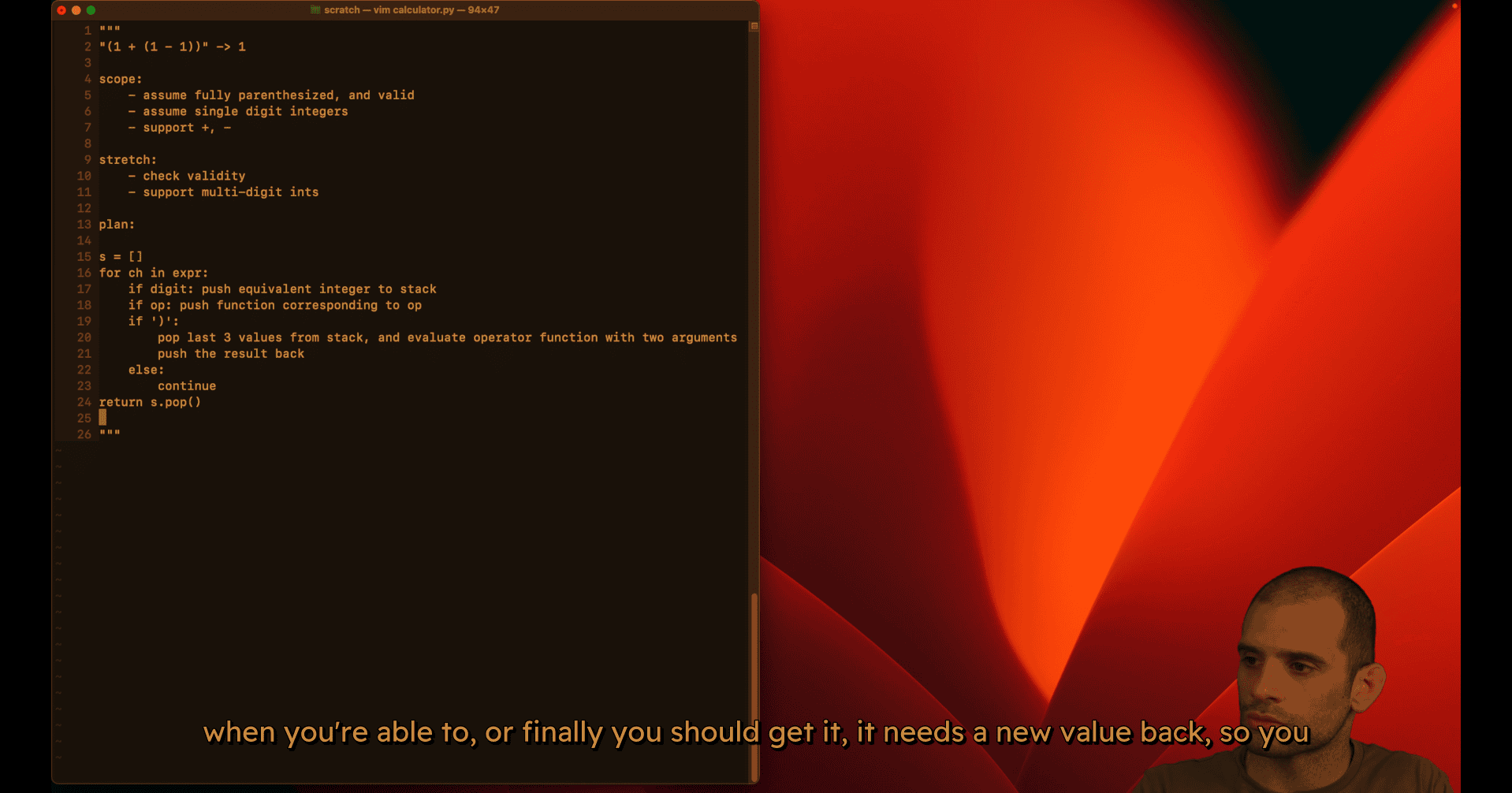
plan :
test case:
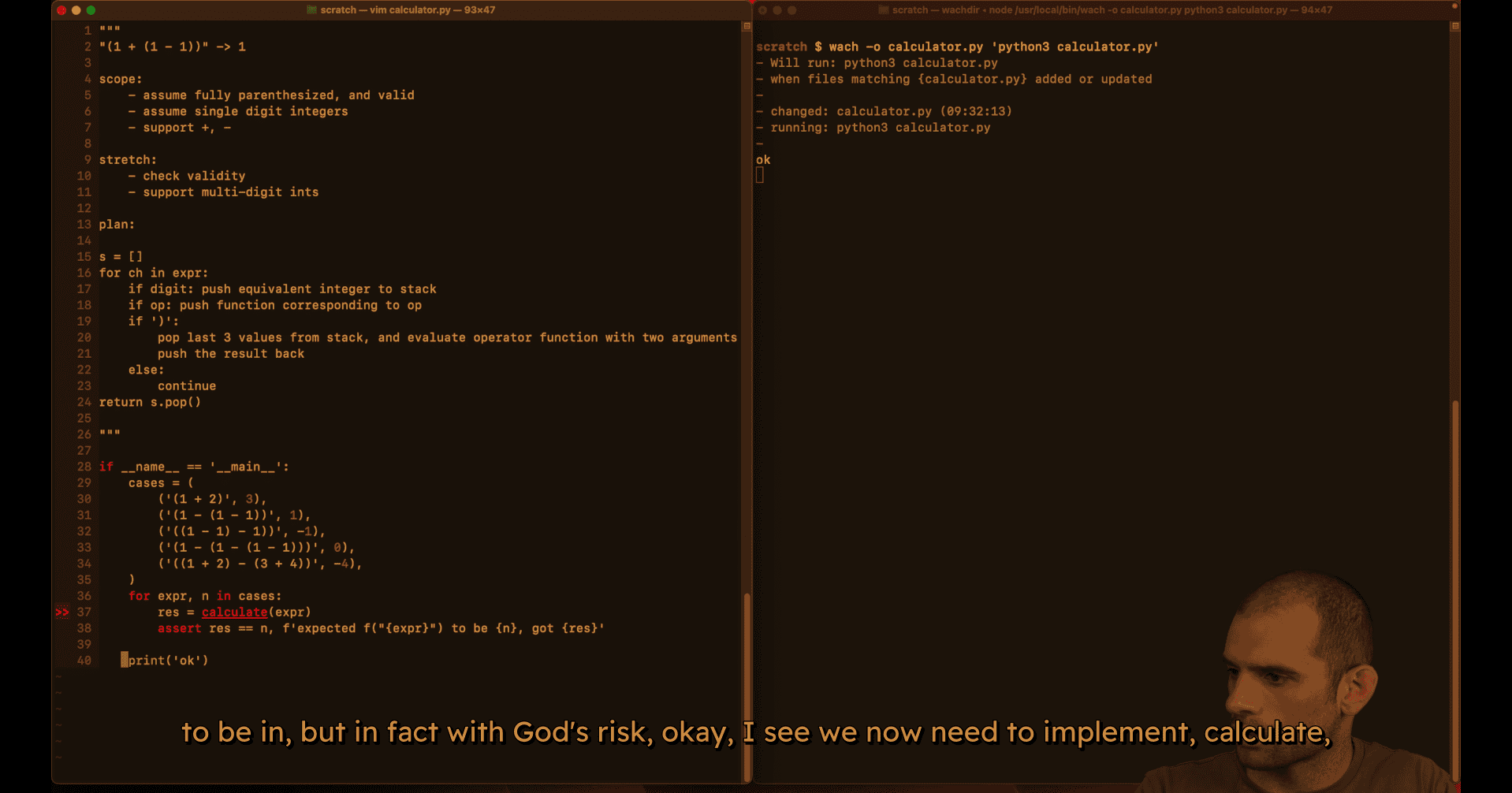
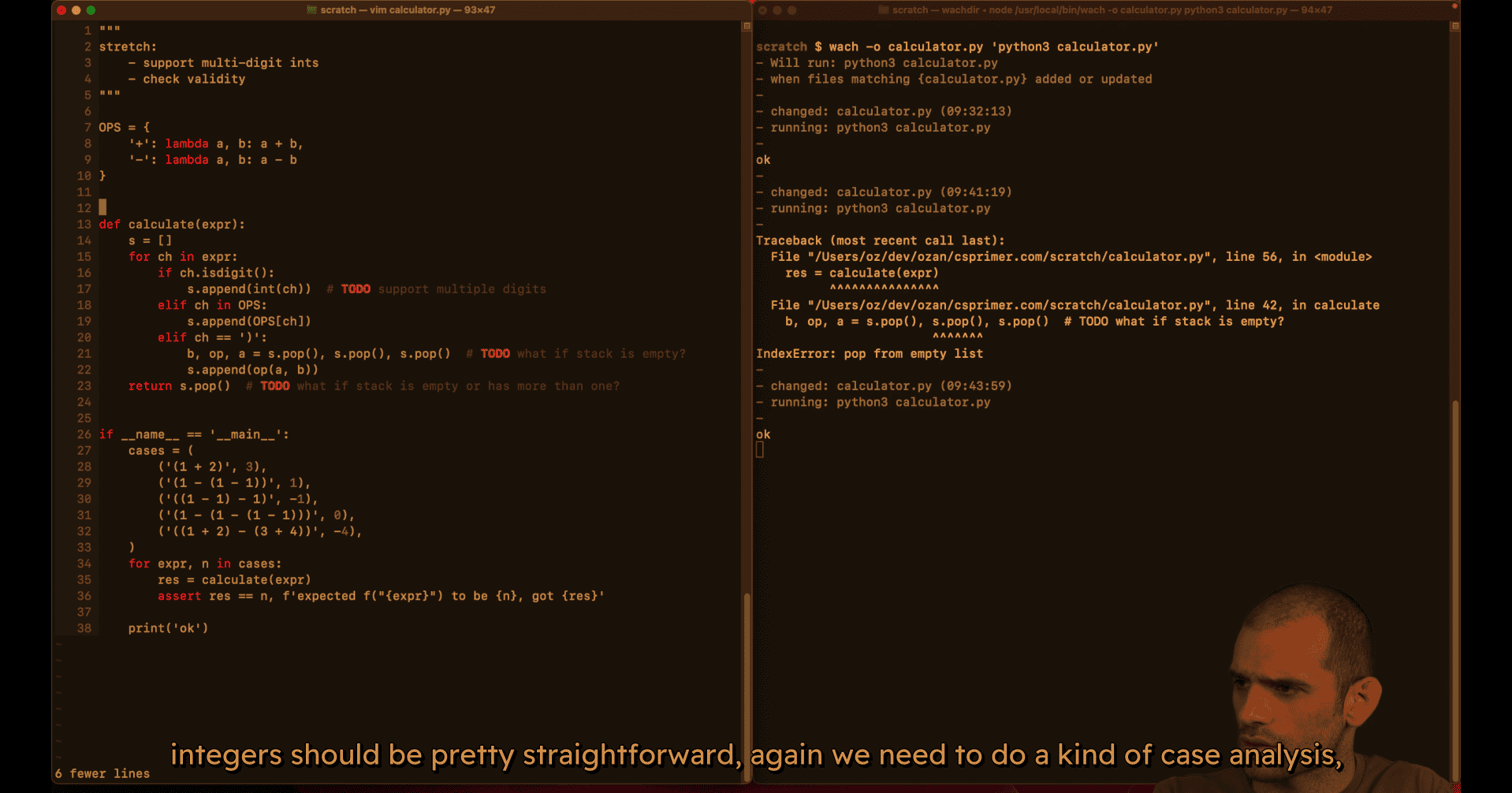
mvp (single digit mode work)
primer logic for double digit :
if len(is) == 0 or not isinstance(s[-i],int):
  s.append(int(ch))
else:
  s[-1]=s[-1]*10+int(ch)
gpt logic:
            # Combine with previous digit if present (multi-digit support)
            if stack and isinstance(stack[-1], int):
                stack[-1] = stack[-1] * 10 + digit
            else:
                stack.append(digit)